Teachers Teaching Teachers #311 - Third Space Learning - August 22, 2012 with Mike Murawski, Christina Cantrill, Ralph Cordova, Nina Simon, Bowen Lee, Fred Mindlin, Chris Sloan, Patricia Swank, Monika Hardy, and Paul Allison
On this episode we are joined by some of the participants from a "3rd Space Conference" in July and others interested in community collaborations. They discuss their learning together in St. Louis last month, and also talk about and how we can bring this work into our local communities in the future, wherever we are.
The 3rd Space Conference, held July 9-13, 2012, in St. Louis, ourcolab.org/the-invitational-summer-institutes-teachers-teaching-teachers/ brought together teams from local sites of the National Writing Project nwp.org and museums around the US to explore creating projects and curriculum that take advantage of collaborations among students, teachers, and local communities.
Learn more about combining the insights and work of artists and museum professionals with hands-on art making and collaborative curriculum design.
Patricia Swank sent us this video "of my students engaging with a piece of art at the St. Louis Art Museum along with some of their theorizing as to how it impacted them."
Third space? Third place? There's a useful summary of some of these concepts on Wikipedia, and it starts like this:
The third place (also known as Third Space) is a term used in the concept of community building to refer to social surroundings separate from the two usual social environments of home and the workplace. In his influential book The Great Good Place, Ray Oldenburg (1989, 1991) argues that third places are important for civil society, democracy, civic engagement, and establishing feelings of a sense of place. --Wikipedia (accessed 8.21.12)en.wikipedia.org/w/index.php?title=Third_place&oldid=500220817
Ralph Cordova's descriptions of the 3rd space work: "The language of envisioning and possibilities signal to us all that what we're about to experience, although principled and theoretically grounded, is completely yet-to-be-invented."
Jump into this conversation with the fascinating educators, artists, museum directors... 3rd Spacers!... and let's see where it takes us!
Click Read more to see a copy of the chat that was happening during the webcast.
Kevin is also the technology liaison with the Western Massachusetts Writing Project umass.edu/wmwp and a co-editor of the book collection Teaching the New Writing: Technology, Change and Assessment in the 21st Century Classroomstore.tcpress.com/ 0807749648.shtml that examines the role of technology in the writing classroom in the age of standardized testing and assessment. Kevin says that he "also dabbles in the world of classroom-based humor" through his Boolean Squared webcomic www.booleansquared.com. In addition to all of these links, go to Digital Is digitalis.nwp.org/users/dogtrax to find a lot examples of his students' work and to see how and why Kevin does what he does in his classroom.
If, like Kevin you're interested to explore visually as well as in text, click away on Kevin's "Clickable Connected Me."
Learn more about Kevin in this webcast, recorded on June 27, 2012.
Click Read more to see a copy of the chat that was happening during the webcast.
Tommy Buteau joins us on this episode of TTT, and it seems perfect to introduce you to him in this Connected Educators Month http://connectededucators.org/. Tommy teaches in Windsor, Colorado http://youthvoices.net/whs/ and he talks about these three connected projects and more:
Add your comments to this post. Let us know what you think about Tommy’s connected pedagogy, and help us look into the future of Youth Voices. http://youthvoices.net. This episode might be a good moment for us to connect to old friends who want to work with us at Youth Voices again or meet new people as well.
Joining Tommy on this episode are:
Shantanu Saha, Monika Hardy, Jeremy Hyler, Deb Kauffman, Gail Desler,Valerie Burton, Chris Sloan, and Fred Mindlin
Click Read more to see a copy of the chat that was happening during the webcast.
On this episode of Teachers Teaching Teachers, +Fred Mindlin/@fmindlin starts with string art, and pulls us into his world of anthropology, story-telling, collaborative learning, and more!
To get the full effect, take a moment to find some string before you listen to this episode of TTT. How much? Fred says, "About two meters or a little over 6 feet is usually a good length. Hold the string between your two hands stretched out as wide as they go, then add about 6 inches."
Fred explains that he was "inspired by the session we had with teachers using Minecraft, where we explored an online game world via another virtual world, http://edtechtalk.com/node/5102 and I was intrigued by whether it would be feasible to explore a meatspace game in our virtual Teachers Teaching Teachers forum." He sees "string games as a gateway to keyboarding and creativity or finger calisthenics, and computer keyboarding: media magic for tradigital storytelling."
Playing games with string is a human cultural universal. This ancient art form is surprisingly helpful in developing both the manual dexterity and strength needed for computer keyboarding. The approach I use for teaching string games to groups also provides a helpful practice ground for some of life's essential skills: creativity, resilience, cooperation, and storytelling.
And that's not all. Here's an excerpt and a couple of photos from a post that Diana wrote shortly after this episode of TTT:
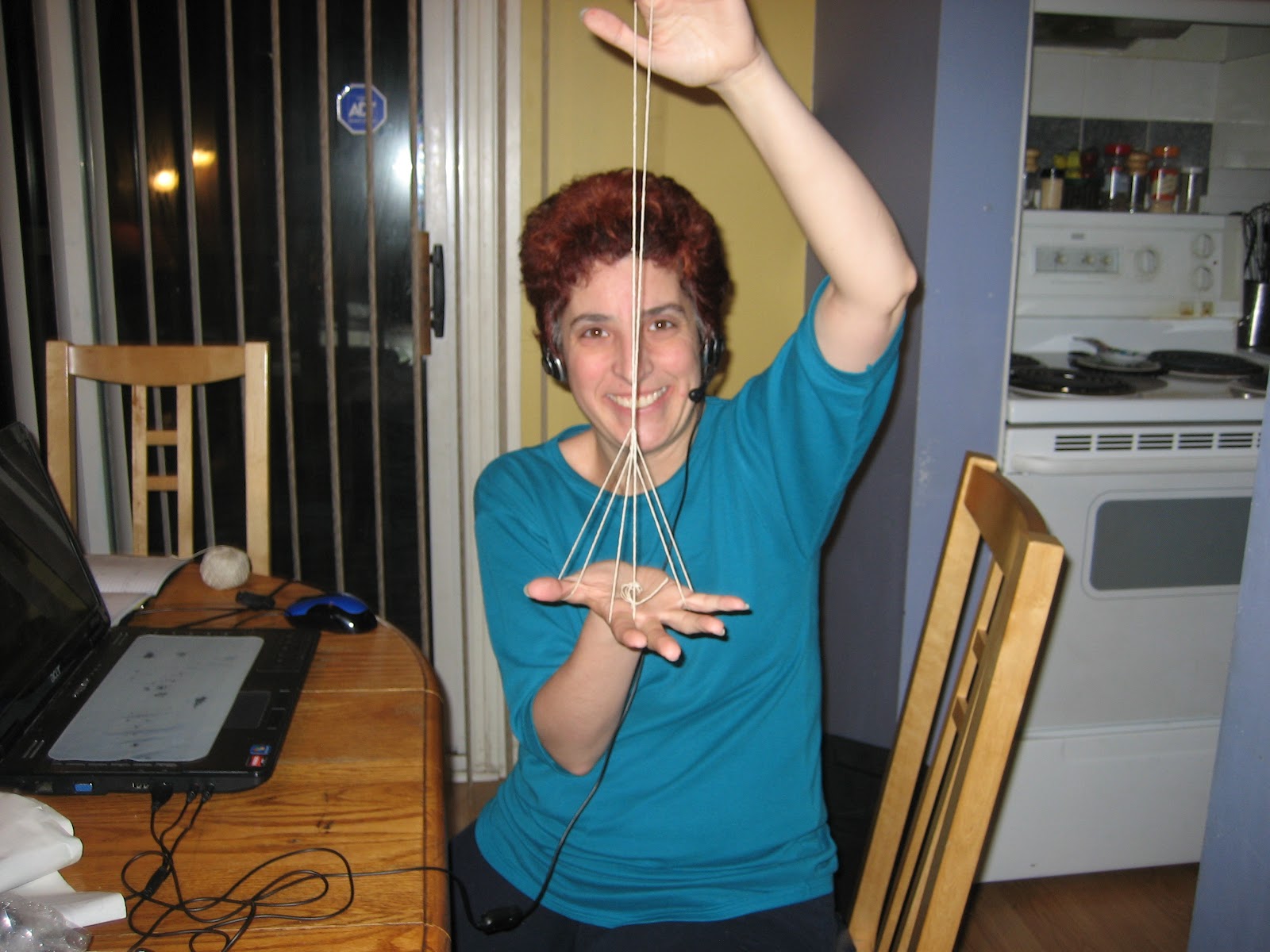
There were some great quotes that Chad, a fellow participant, shared via Twitter. (I can't recall them all - they were things like "it's important to model failure" and "string games are 'digital' fun".) What I realized was how potent teaching string games would be to analyze your own teaching practice. Listening to Fred teach the group how to make a 3-pronged spear made me hyper-aware of how important detailed, clear instructions are, and the different learning styles at play. The first time I tried it, I failed. The second time, when Fred re-explained and added a few "notice this part here" tips, I did it! I cheered pretty loudly when I succeeded. My webcam wasn't working on Google +, so I convinced my daughter to take a photo of my accomplishment.
I made a 3-pronged spear! Here's proof!
A less complimentary shot of me, with my string jedi master Fred on-screen
Fred mentioned that there are several books and YouTube videos that explain, step by step, how to make different shapes. I think I need a person near me to give feedback (though the string collapsing in unrecognizable shapes is pretty immediate feedback too). I gave myself a goal - to teach the kids in my SK and Grade 7 classes how to make the 3-pronged spear and do it to music at a June assembly. I'm repeating it here so it'll be my contract to myself to try it out and report what results.
Do you have your EdTechTalk stuff yet? Did you know there are T-shirts, hats, coffee mugs, buttons, magnets, and tote bags available? They're all based on Wordle interpretations of the EdTechTalk Delicious tags.
What are you waiting for? These are limited edition items. Shop now and avoid the rush!