

Susan_Ettenheim
Teachers Teaching Teachers #101 - Collaborating in the Bering Sea - 04.23.08
Submitted by Paul Allison on Tue, 2008-04-29 01:09.57:00 minutes (13.02 MB)
On this podcast Susan Ettenheim and Paul Allison are joined by John Concilus, Director of Educational Technology, and a student from one of the schools in the Bering Strait School District. John introduced himself a few weeks ago by responding to an earlier podcast with a "Comment and Invitation for Collaboration."
Learn more about the Bering Strait School District and their work with technology. Then this Wednesday, April 30, join John Concilus again, plus a teacher from Brevig Mission, AK, Ginger Crockett, and others. Woody Woodgate and a colleague may be joining us as well. (Maybe we'll finally find out more about that seal hunt.)
We are excited to continue our connections with teachers in Alaska, and in particular we want to learn more about "place-based education." Here's what John said in a recent email:
We've already decided at the budget meeting to move forward with our Digital Foxfire program next school year. I'll have more information about this by Wednesday, but will have a form set up by then for having potentially intersted partner schools sign up.
Brevig Mission School map
placed-based education
http://edtechtalk.com/node
edtech@bssd.org
blog.bssd.org
Some projects involving sites in multiple locations using our Wiki, Ning, etc...
http://wiki.bssd.org/index.php
Teachers Teaching Teachers #100 - Making Space on Youth Twitter - 04.16.08
Submitted by Paul Allison on Mon, 2008-04-28 00:09.38:40 minutes (8.84 MB)
Just before the second issue of Space was published, Susan Ettenheim and Paul Allison, from the New York City Writing Project, were joined by:
- Kevin Hodgson, a sixth grade teacher from the Western Massachusetts Writing Project
- George Mayo, an 8th grade teacher from Maryland, and one of his students Pablo, an editor of the second issue of Space.
- Chris Sloan, a high school teacher from the Wasatch Range Writing Project in Salt Lake City, and one of his students, Dane
- Hannah, a student from the Science Leadership Academy in Philadelphia
Join the fun!
- Listen to this podcast, as we bounce ideas off each other and plan future collaborations.
- Please share Space, Issue #2 with your students.
- And register your students at Youth Twitter.
2008space - via kwout
Teachers Teaching Teachers #99 - From elgg to Drupal? - 04.09.08
Submitted by Paul Allison on Wed, 2008-04-23 18:43.69:20 minutes (15.88 MB)
For this webcast, we invited Bill Fitzgerald, Dave Cormier and Gail Desler to talk about social networking and what platforms make sense right now. Of course behind all of this talk about Drupal and Edublogs were questions that we are asking about about how we in the, ah... Teachers Teaching Teachers, Youth Voices, Personal Learning Space, Youth Twitter ... group of teachers might want to continue working together ... and how the software decisions we need to make this Spring can support our hopes and plans.
Teachers Teaching Teachers #98 - Learning to be Unschooly - 04.02.08
Submitted by Paul Allison on Wed, 2008-04-23 13:57.44:35 minutes (10.19 MB)
Earlier this month, on Youth Twitter, a student in South Korea, Soojin wrote, "just my opinion about youthtwitter: schooly. concrete."
A bit later, Hannah, a student in Philadelphia, answered on Youth Twitter, "I think Alan's survey is a good example of how not to be 'schooly'. Students should ask questions of each other and interact."
Wow,
we thought this would be an interesting conversation on Teachers
Teaching Teachers. Perhaps we could have more of a Students Teaching
Teachers show.
We invited Soojin,
Hannah, Alan, a student from Queens, NY, Lindsea, a studnet from
Honolulu, and Ben, a student from NYC to talk about the possibilities
and problems with http://youthtwitter on our live webcast, Teachers Teaching Teachers.
What a great a conversation we had about Youth Twitter, and blogging, and social networking and blogging-beyond-school.
OH! We also invited some of the students' teachers. Their insights were invaluable.
We were excited to have Clay Burell, Madeline Brownstone, and George Mayo join us for this conversation as well.
Here's
the first paragraph of a blog post that Soojin wrote the day after the
webcast. (Click the link to read the whole post, and the responses.)
Enjoy! And pass this podcast on to your students for inspiration.
Unschooly-Youths Conversations Reflection
Posted on April 4th, 2008 by SoojinApril 3rd, 2008 10:00 AM GMT+09, something new happened to my life. Well, yes to quote me that was my “first time Skyping for real-purposes” and, of course, “with bunch of White-people” that lasted more than an hour hosted by a group called TeachersTeachingTeachers (not to forget mentioning Clay Burell’s impression that it was more like StudentsTeachingTeachers :-). Many feelings crossed my heart. Oh well, yes, I was pretty nervous at first I won’t deny (so childish!). And at the same time I was very honored to join this group of 9 out of 6 billion, members consisting of Clay Burell, Paul Allison, Susan Ettenheim, Madeline Brownstone, Lindsea, Hannah, Alan, Mr.Mayo, and Ben, talking about the leading form of education that all world will eventually have (sorry that I couldn’t link all names; please tell me your addresses). Paul told me during the conference that my tweet in YouthTwitter: just my opinion about youthtwitter: schooly. concrete was one of the key inspiration for opening such meeting. Actually, when I decided to tweet that I was afraid if I offended anyone in YouthTwitter but I decided to become honest because I wanted YT to improve. I’ve been blogging since last year, connected since about a month ago, and now I made a difference. Very meaningful.
No Music No Civilization » Unschooly-Youths Conversations Reflection
Teachers Teaching Teachers #97 - Foxfire for the Firefox Generation - 03.26.08
Submitted by Paul Allison on Mon, 2008-04-14 00:04.45:00 minutes (10.34 MB)
This podcast be
gins with a focus on the work of two technology teachers and two students from The Baccalaureate School for Global Education
(BSGE) in Astoria, NY. Madeline Brownstone and Shantanu Saha describe
their two-year technology curriculum that has students doing global,
multimedia projects.
Madeline and Shantanu have been working with
schools here in the US through the New York City Writing Project and
World Bridges/EdTechTalk. And their students have been participating in
a project with a school in the Netherlands with iEarn.
More recently
their students have also begun working with teachers and students
involved with the Horizon Project,
which was founded by Vikki Davis and Julie Lindsay. Listen to hear how
these teachers and students integrate these national and international
projects with the curricular expectations of a technology
concentration that leads to an International Baccalaureate (IB) Diploma.
That might be enough, but Madeline and Shantanu and their students also
found wonderful ways to relate their work to the collaborative study of
rural culture that is being planned by Lee Baber in Virginia and Woody
Woodgate in Alaska. Woody tells his students that they are natives of
Alaska and the digital worlds.
In this podcast we explore all of these ways of connecting urban, rural, global, and digital youths!
Teachers Teaching Teachers #96 - Has digital storytelling changed writing? - 03.19.08
Submitted by Paul Allison on Wed, 2008-04-02 03:14.63:15 minutes (14.45 MB)
This spring Susan Ettenheim and Paul Allison are experimenting again. This time with Hypertextopia. We have just begun to explore with our students how writing changes in this online environment.
To learn more, we invited Mark Bernstein and Jeremy Ashkenas to have a conversation with us.
- Mark Bernstein has been Eastgate's chief scientist since 1987. He has developed Storyspace and other hypertext software, and he is the publisher of wonderful hypertexts.
- Jeremy Ashkenas is working on Hypertextopia as a part of his final project for his undergraduate degree at Brown University.
We were inspired to invite the spunky programmer/publisher to talk with the upstart literature/computer undergrad after reading through this recent thread on if:Book. Listen to learn more about hypertext writing online, and join us at Hypertextopia!
Teachers Teaching Teachers #95 - Locating the Tyranny of Filtering - 03.12.08
Submitted by Paul Allison on Mon, 2008-03-24 02:15.45:15 minutes (10.37 MB)
It's happening in small, geographically dispersed schools in rural Alaska. Three people are responsible for doing it
for over a million public school students in New York City. An
independent school in Milwaukee uses the same software that is being
used in NYC to do it. In Colorado, an outspoken opponent of it
was recently hired for a district level job, and now he is on a small
committee that gives the thumbs up or down. In North Dakota, a secret
password is emailed each week to a group of thirty teachers who can
then undo it in their schools,
when needed. In rural Virginia, a teacher carefully measures her
arguments for the educational benefit against the possible risks each
time she requests for it to be undone. Because so many schools do it
in so many different ways, the developers of VoiceThread have to work
overtime to keep their Web 2.0 tool available in public schools.
In September, Wesley Fryer "observed from China that the level of content filtering / censorship enforced by the central,
totalitarian government was actually LESS severe than the content
filtering enforced in many U.S. public schools" (Content filtering in Communist China versus an Oklahoma school » Moving at the Speed of Creativity).
Really? Do the descriptions in the first paragraph accurately represent
the tyranny of filtering in U.S. schools today? Or do teachers have
more power than we often exercise? It's become too easy for educators
to represent filtering as if it's something that oppresses us. What if
we find that the enemy is us?
From the discussion captured on this podcast, we can sketch a much more
complicated picture of how filtering really seems to work in U.S. schools. See what we mean by clicking Read more, below.
Teachers Teaching Teachers #93 - Open Curriculum Planning - 02.27.08
Submitted by Paul Allison on Mon, 2008-03-10 00:24.74:55 minutes (17.13 MB)
Imagine, if you would, your department meeting webcast live every month or so. At it's core, that's what we aim for at Teachers Teaching Teachers, and there's more. In this podcast, we go back to the basics, back to the making public our private curriculum discussions. Five National Writing Project teachers and two guests joined together to check what our students were doing and what we were thinking. We work together with a group of sites:
- Youth Voices social network of 9th - 12 grade bloggers
- Personal Learning Space - social network of 6th - 8th grade bloggers
- Elggplans Wikispace - a wiki where we gather collaborative plans
- Youthwiki Wikispace- a wiki for youths to share multimedia in galleries of work
- Youth Bridges - youth podcasting network
- Youth Twitter - a safe, twitter-like blogging network for students
- 10 self 10 world questions
- 12 steps to a post with image, comments, and reflection
- Be a blogger - Self Assessment Guide
- Be a blogger! - Hypertext version
- Chris Sloan, Salt Lake City, Utah
- Bill O'Neal, Trenton, New Jersey
- Lynne Culp, Los Angeles, California
- Mike Sansone, Iowa
- Jim Sigler, Missouri
Teachers Teaching Teachers #91: Tagging, Tumbling, and Mathcasting 02.13.08
Submitted by Paul Allison on Wed, 2008-02-27 05:56.39:00 minutes (8.95 MB)
This is a jam-packed thirty-nine minutes, where we explore the power of tagging, teachers using tumblogs, mathcasts, VoiceThreads in health, speech, history, math, music, technology, and EFL classes. Join Paul Allison, Lee Baber, Susan Ettenheim, and VoiceThread's Ben Papell (Yes, he's a "regular" by now), as they welcome these fresh voices, fresh at least to us at Teachers Teaching Teachers:
- Carla Raguseo, an EFL teacher and Computer Lab coordinator at A.R.I.C.A.N.A., a Binational Center in Rosario, Argentina
- Carla Arena, a Brazilian EFL teacher, teacher trainer and site content manager at A Binational Center in Brasilia, but she's on a leave right now.
- Jeremy Brown, a Special Education Teacher at the Medow Hall Elementary School in Montgomery County, Maryland
- Judi Epcke, a teacher and Technology Integration Specialist in Northbrook, Illinois
- Tim Fahlberg, founder of Mathcasts, after 11 years as a math teacher.
Teachers Teaching Teachers #90: Microblogging our way toward global awareness 02.06.08
Submitted by Paul Allison on Tue, 2008-02-19 19:07.49:00 minutes (11.27 MB)
Some educators, including some of us who meet regularly on Teachers Teaching Teachers, have begun to find places in our curriculum for microblogging.
encouraging shorter posts, it lowers users’ requirement of time and thought investment for content generation. This is also one of its main differentiating factors from blogging in general. The second important difference is the frequency of update. On average, a prolific blogger may update her blog once every few days; on the other hand a microblogger may post several updates in a single day.” (Java Akshay, Tim Finin, Xaiodan Song, Bell Tseng, Why We Twitter: U
nderstanding Microblogging Usage and Communitites. August 12, 2007)
Teachers Teaching Teachers #89: Is the tool irrelevant? 01.30.08
Submitted by Paul Allison on Sun, 2008-02-10 23:43.40:00 minutes (9.19 MB)Listen to Scott Floyd, Tech Liaison for the Texas Bluebonnet Writing Project, and Ellen Petry Leanse explain how and why they collaborated on a project that resulted in this VoiceThread, as well as other media versions of the same story. Scott writes on his blog:
Ellen Petry Leanse has a powerful story to tell of her escape from the political unrest in Kenya during the presidential elections over the 2007 Christmas holidays. She and her 12 year old son were there volunteering in an orphanage as well as other humanitarian work. I first encountered her story January 15th on Guy Kawasaki’s blog as a guest post. Her writing moved me. Something inside of me kept saying to contact her and help her share what she and her son went through. As Google would have it, her email came up in the first try, and by 8:11 AM I sent off a personal plea to her to share her narrative through digital storytelling.
A Piece of My Mind - my ideas, thoughts, experiences, and lessons learned in education The founders of VoiceThread, Ben Papell and Steve Muth, also join us in this discussion of the lessons that can be learned from this one example of digital storytelling.
Teachers Teaching Teachers #88 - Me and my inquiry in relation to a whole community of learners - 01.23.08
Submitted by Paul Allison on Wed, 2008-01-30 05:55.40:00 minutes (9.15 MB)
Listen to seven National Writing Project teachers plan a Spring Blogging curriculum together.
Find out if seven people can plan a curriculum together over skype. These seven teachers from Writing Projects across the country met and planned a 15-week blogging curriculum that they have started to put together (click read more).
- Bob Levin and Gail Desler (Area 3 Writing Project, Sacramento, CA)
- Woody Woodgate (Alaska Writing Project, Marshall, Alaska)
- Bill O'Neal (Trenton, NJ Writing Project)
- Chris Sloan (Wasatch Range Writing Project, Salt Lake City, Utah)
- Paul Allison and Susan Ettenheim (New York City Writing Project)
by shankargallery
Teachers Teaching Teachers #87: Spin the Globe--A conversation with Graham Wegner, Doug Noon, and Joel Arquillos--01.16.09
Submitted by Paul Allison on Tue, 2008-01-22 03:46.68:35 minutes (15.71 MB)Graham Wegner, Doug Noon, Joel Arquillos joined us to think about collaborative projects that Spin the Globe.

Many of us have have enjoyed reading both of Graham Wegner's and Doug Noon's blogs [ http://gwegner.edublogs.org and http://borderland.northernattit
Woody Woodgate -- who teaches in Marshall, Alaska, and has been doing all sorts of wiki and blog and Voice Thread projects with us here in New York City and elsewhere [ http://youthwiki.wikispaces
As we plan this work, we are looking at other examples of urban/rural exchanges such as the exchange between Joel Arquillos' students in San Francisco and David Boardman's students in a town in Maine.
When Joel Arquillos, a social studies teacher at the Galileo Academy of Science and Technology in San Francisco, started his 11th-grade American history students blogging, he didn't know what to expect. Mr. Arquillos set up a group blog as a joint project with David Boardman's English class juniors and seniors from rural Winthrop High School in Maine for students to post assignments online, comment on each other's work and expand their cultural awareness. At first, the students needed to be prodded to post. But the blog took off when Mr. Arquillos had them write about their neighborhoods. A student who lives in the Tenderloin district in San Francisco described her feelings about the drug dealing and gang violence in the neighborhood. The Maine students posted that they had thought neighborhoods like the Tenderloin were urban legends. Soon, the students started posting on their own to find out what their peers cross-country thought about various subjects (the structure of the new SAT's, good reasons to skip the prom, etc.), discussions that almost came to match the assigned writings in volume. "I want to give these kids the tools to say, 'Hey, my voice is important in this world,' " Mr. Arquillos said after the yearlong experiment. "This blog helps me do that."
New Tools: Blogs, Podcasts and Virtual Classrooms - New York Time
Here's the kind of frank, thoughtful conversation you will hear on this podcast:
Graham calls it a grassroots collaboration. And that, it is. He set up a wiki last August called Spin the Globe. It’s a web space where his class and mine can hopefully learn from each other about our respective far-flung parts of the world. Graham gave it a fair review, but I haven’t had a lot to say about it because it hasn’t really come together for me and my group yet. But we’re getting there, and now, since Paul Allison invited me and Graham to discuss it this evening on the Teachers Teaching Teachers podcast, I’m sorting through my reactions to the project so far.
Borderland » Blog Archive » Classroom Collaborative Give and Take - by Doug Noon
I’ll be honest here and state the goals that Doug and I negotiated have been our guiding light because the process and the final product has been constantly malleable and subject to redefinition. The big difficulty was making this project important to two very different groups of students living very different lives. My class enjoyed the advantage of being the initiators and being very settled as we were well into the second half of our school year. They knew me, I knew their capabilities and by that stage in the year I knew them all well enough to enthuse them about this mysterious project we were doing with “the kids from Alaska”. Doug, on the other hand, was just starting his new school year and was still working out his group’s particular tendencies and skill sets. From my perspective, his position was always going to be trickier to manage. But I have to pay tribute to his support, his diplomomatic balancing of some of my hare-brained ideas and ultimately suggesting ways to get around some of the barriers (cultural and technological). One of the best pieces of advice actually came from his wife, also a teacher, who pointed out that a top-down approach that dictated specific roles and topics for students was somewhat at odds with the inquiry based approach we were actually wanting for them. In my class, the project gained its largest boost of momentum when I spoke to my students and announced that the shackles were off and they were free to develop whatever pages of the wiki they wanted. After all, Wikipedia contributors don’t get assigned to write specific articles by a superior. I know that a classroom effort can’t be quite as organic as that but productivity and engagement went up noticeably from that point on.
Teaching Generation Z » Blog Archive » Spin The Globe - Adelaide Meets Fairbanks by Graham Wegner
Chat Log for TTT#87 - 01.16.09
20:14:44 Mdodes -> -EdTechTalk: Good evening!
20:15:04 tkidd132 -> -EdTechTalk: Good Evening Are we the only ones here....lol
20:15:09 Mdodes -> -EdTechTalk: yup for the moment
20:15:13 Mdodes -> -EdTechTalk: still another 45 minutes
20:15:18 tkidd132 -> -EdTechTalk: Oh ok
20:15:38 tkidd132 -> -EdTechTalk: Hola Nick
20:15:48 Mdodes -> -EdTechTalk: One second
20:15:52 nick -> -EdTechTalk: hi
20:15:58 Alex Hayes -> -EdTechTalk: hi there !
Teachers Teaching Teachers #86 Giving All Schools Access to VoiceThread-A Conversation with Ben Papell and Steve Muth-01.09.08
Submitted by Paul Allison on Mon, 2008-01-14 12:08.46:56 minutes (10.8 MB)
Ben Papell and Steve Muth are fed up with the number of school districts across the US that are bocking VoiceThread. Even though VoiceThread was one of the most popular Web-tools with educators in 2007, it has also been unavailable to many teachers because of district or school filters that block all free websites or sites that allow for user contributions or that allow students to surf to unapproved content... or for whatever reasons. All Ben and Steve know is that they've been getting a steady stream of emails that say something like: "I love, love, love VoiceThread! I use it at home, but I can't use it in my school. It's blocked! Is there any way you can help?"
Ben and Steve are not the first developers of tools like VoiceThread to run into problems like this. They may be the first to come up with a solution that not only solves the blocking problem, but potentially makes their product even more attractive because it will give students of all ages free (to them), unlimited access to their own VoiceThread accounts that teachers can manage without using email addresses. Here are some of the details that Ben and Steve provided:
The Ed.VoiceThread network is a worldwide community where safety is built upon a foundation of accountability. All users are known users, responsible for their content and behavior. Access is restricted to K-12 educators, students and administrators, and all content is created exclusively by registered members of the community. Web services offering free accounts are blocked in many school districts because of child online protection policies, and are not eligible for federal eRate monies. For this reason, there are no free Ed.VoiceThread accounts and student email addresses are not required. Educators must pay a one time $10 verification fee to become a member of the community, with no recurring costs.
Schools will also be able to pay a monthly fee (about $100), which will make it possible for all teachers in the building to use VoiceThread with their students.
Learn more about this innovative plan on this webcast. Ben Papell and Steve Muth joined us once again to explain changes they are making to address access problems in US schools.
Ed.VoiceThread goes live on Thursday, January 17. Get the inside story on this podcast.
Teachers Teaching Teachers #85 - 01.02.08 - Old and New Ring in the New Year
Submitted by Paul Allison on Wed, 2008-01-09 12:24.69:25 minutes (15.91 MB)
We were joined by many old and new voices as we brought in the new year with music and stories of things that changed our teaching last year.
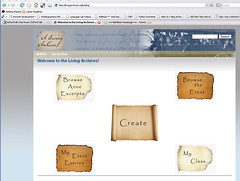
Teachers Teaching Teachers #84 - Old School Meets New School: A Chat with Dave Cormier and Bonnie Stewart on A Living Archives
Submitted by Paul Allison on Tue, 2008-01-01 19:03.44:05 minutes (10.15 MB)
Dave Cormier and Bonnie Stewart joined this show to discuss their project "A Living Archives." As you will hear them explain, this project, which is funded by Canadian Heritage, has students from all three school districts on Prince Edward Island (PEI) using leading edge technologies to bring PEI history and heritage to life. Bonnie and Dave have been building partnerships between the University of Prince Edward Island, the Provincial Archives and Records Office, the PEI Museum and Heritage Foundation, the PEI Library, and the three PEI Boards of Education.
Click Read more to find out what what Dave wrote about "The Living Archives project" in July 2007.
Teachers Teaching Teachers #83 - Tagging, Ceramics, Digital Photography, and More
Submitted by Paul Allison on Mon, 2007-12-17 03:55.45:00 minutes (10.31 MB)
- Paul Allison, East Bronx Academy for the Future, Bronx, NY
- Lee Baber, J. Frank Hillyard Middle School, Broadway, VA
- Susan Ettenheim, Eleanor Roosevelt High School, New York, NY
- Russ Knopp, Preston Hall Middle School, Waitsburg, WA
- Matt Montagne, University School of Milwaukee, WI
- Bill O'Neal, Trenton High School West, Trenton, NJ
- Chris Sloan, Judge Memorial High School, Salt Lake City, UT
- Woody Woodgate, Marshall School, Marshall, AK
Teachers Teaching Teachers #81 - Looking for the Passions and Keeping the Faith
Submitted by Paul Allison on Mon, 2007-12-03 03:16.43:00 minutes (9.83 MB)The week before Thanksgiving, many National Writing Project (NWP) teachers participated in the NWP's Annual Meeting. Several presenters at the 2007
Annual Meeting joined us for a live webcast on Wednesday, November 28th. This is an edited podcast of that conversation with these teachers:
- Cynthia Calvert, Alcorn Writing Project
- Jason Shiroff, Denver Writing Project
- Lynne Culp, UCLA Writing Project
- Kevin Hodgson, Western Massachusetts Writing Project
- Peter Kittle, Northern California Writing Project (invited)
- Christina Cantrill, NWP Program Associate in Technology
We asked pairs of teachers who presented at the NWP Annual meeting to continue their dialogue on this webcast. We focused on their collaboration before, during, and perhaps after their face-to-face presentation. Find out what their conversations and questions are now.
The theme of the webcast was about how moments where teachers have the opportunity to gather and share practices, such as the NWP's Annual Meeting, are important points along the continuum of on-going conversations and sometimes even collaborations which begin long before the "events" and which often last long after.
We asked our guests to tell us what they learned from planning and presenting together -- both from each other as well as the extended network -- for their Writing Project sites as well as their classrooms.
Teachers Teaching Teachers #79: Helping students blog their passions, hunt caribou, share culture, and feed elggs with RSS
Submitted by Paul Allison on Sun, 2007-11-25 18:20.42:45 minutes (9.8 MB)
Find out what happens when you bring together seven teachers and a student to talk about perennial questions that come up when we use blogs in the classroom.
- a 6th-12th grade "New Journalism" teacher from the Bronx (with laryngitis) (Paul Allison)
- a half-time computer teacher/half-time technology coach from a town west of Chicago, "right about where the corn begins" (Scott Meech)
- a high school art/technology teacher and librarian from New York City (Susan Ettenheim)
- an 8th grade computer technology teacher and Webhead from Virginia (Lee Baber)
- a math/science/employability skills/hunting safety teacher from Alaska (Woody Woodgate)
- a ninth grader from a small town in the Shenandoah Valley in Virginia (Victoria)
- an eighth grade science teacher from northern New Hampshire (Rick Biche)
- a middle-school technology integrator from an independent K12 school in Milwaukee, Wisconsin. (Matt Montagne)
Image: "Stalking a Caribou" by Travis S. (http://www.flickr.com/photos/baggis/1735135201/) License: http://creativecommons.org/licenses/by-nc/2.0
Teachers Teaching Teachers #78 - Digital Composing and the National Writing Project's Annual Meeting
Submitted by Paul Allison on Sun, 2007-11-11 18:43.43:45 minutes (10.03 MB)
This is the first of two shows in November in which we are going to sandwich the National Writing Project's Annual Meeting with two special Teachers Teaching Teachers webcasts/podcasts, one before and one after the Annual Meeting: Nov. 15–17,
For this show we invited Writing Project Technology Liaisons who are coming to present in New York City to join us to give us a taste of what will be happening at this vital conference.
Listen to learn what it is that brings us together each year. Learn more about how Writing Project teachers are using digital storytelling (or digital composing) in their classrooms, in summer youth camps, and with other teachers in their local Writing Projects.
Joining Paul Allison, Susan Ettenheim, Lee Baber, and Woody Woodgate on this week's special Teachers Teaching Teachers were
- John Bishop, Red Clay Writing Project
- Clifford Lee, Bay Area Writing Project
- Bonnie Kaplan, Hudson Valley Writing Project
- Valorie Stokes, Prairie Lands Writing Project
- Paul Oh, National Writing Project
Teachers Teaching Teachers #77 - Participation is the Most Important Part
Submitted by Paul Allison on Thu, 2007-11-01 10:54.74:15 minutes (17.05 MB)
We were joined this week by Joyce Valenza and the co-founders of of Voice Thread, Ben Papell and Steve Muth (and many wonderful teachers in the chat room). In the spirit of producing content that is open to co-creation...
...we invite you add an interesting Voice Thread to this post. Either link to or embed a Voice Thread that would help show how teachers are using this tool in their classrooms or with their colleagues.
Click Add new comment, and show us a Voice Thread that you think is cool!
Thanks.
Teachers Teaching Teachers #68 - Information for All!
Submitted by SusanEttenheim on Thu, 2007-11-01 00:01.51:30 minutes (11.77 MB)
Here, finally is Teachers Teaching Teachers from August 22, 2007. My most sincere apologies for the delay. As you might know, the echo has long been fixed but the editing job of that evening remained for a long time! Thanks for your patience - enjoy the show. It was a good one!
Some notes:
You are invited to Teachers Teaching Teachers tonight and join in the conversation about using State Online Virtual Library Databases in k12 education- especially as a source for information in blogging conversations.
Joining us tonight, will be Nancy Keane, who taught the online class this past summer for YALSA about teens and database use and Michael Gorrell, the Chief Information Officer for EBSCO (thank you Karen Minton of GALILEO, Georgia for making the connection!) As a Dad of 5 boys, Michael understands our cries for support and greater understanding about using these resources. Join us to learn new info from the inside!
We also welcome back Kate Storms of NOVEL, New York, Sylvia Nortonof MARVEL, Maine, Karen Minton and Courtney McGough of GALILEO, Georgia.
Did you do your homework for tonight? Please make sure that you have tried a search in your state virtual library and have noted your results and experiences.
Add to the Google Notebook:
http://www.google.com/notebook/#b=BDQOrSwoQsJqSocci
(just email me if you don't have editing rights settenh@schools.nyc.gov)
Read Paul's experiences:
http://teachersteachingteachers.org/?p=130
Be sure to check back later today at the blog and the notebook for Michael's notes.
Watch Joyce Valenza's wonderful new Voice Thread
Why I Love Databases
http://voicethread.com/view.php?b=4799
Teachers Teaching Teachers #76 - Coming and Going from Georgia, California, New York, Utah, Virginia...
Submitted by Paul Allison on Wed, 2007-10-31 00:34.60:55 minutes (13.94 MB)
Join our virtual staff room as we check in with a couple of 9th graders from Virginia--Victoria and Zack--along with teachers from these schools:
- East Bronx Academy for the Future, New York City - Paul Allison
- J. Frank Hilliard Middle School, Shenandoah Valley, Virginia - Lee Baber
- High School at UCLA, California - Lynne Culp
- Westwood Schools, Camilla, Georgia - Vicki Davis
- Eleanor Roosevelt High School, New York City - Susan Ettenheim
- Florin High School, Sacramento, California - Bob LeVin
- Judge Memorial High School, Salt Lake City, Utah - Chris Sloan