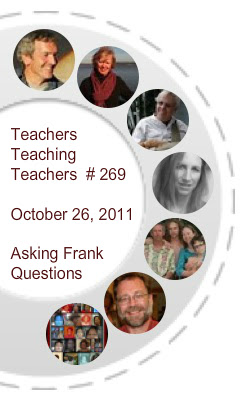
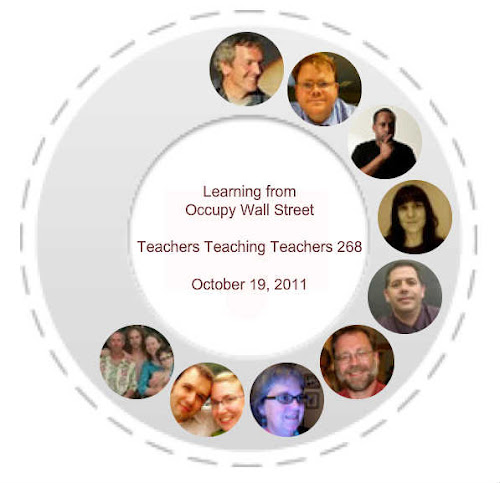
On this episode of Teachers Teaching Teachers, we get together and talk about Youth Voices with Alice Barr, Matt Montagne, Sandy Scragg, Sheri Edwards, Shantanu Saha, Valerie Burton, Chris Sloan, and Paul Allison.
Click Read more to see a copy of the chat that was happening during the webcast.
48:00 minutes (10.99 MB)
On this episode of Teachers Teaching Teachers, meet Tommy Buteau and learn more about Chad Sansing and the Cooperative Catalyst. Tommy recently wrote Paul Allison.
Paul,
I read about the Youth Voices project at the Digital Is site, and I think it sounds very interesting, like something I would use with my 9th and 11th grade English classes here in Windsor, CO. So, I visited the site and signed up, but it seems like I do not have access to everything. I can only see three of the guides that you use, and the directions for most of the activities seem limited. I enjoyed the free-writing article by Peter Elbow, and I also like the 10 questions activity. I am wondering if there is a description of how teachers use this site somewhere.
Thanks, Tommy Buteau
That’s not all, a couple of days later Tommy wrote:
We couldn't wait to welcome Tommy into our community and to learn more about his work. We were also delighted to welcome Chad Sansing back to TTT. You can see the results of the challenge we threw to him on TTT #256 - Cooperative Catalyst.
On this episode of Teachers Teaching Teachers, a group of us who are in the process of launching a new version of Youth Voices met to continue the process of building the technology and the pedegogy of our work together.
Youth Voices is a school-based social network that was started in 2003 by a group of National Writing Project teachers. We merged several earlier blogging projects, preferring to bring our students together in one site that would live beyond any particular class, where it would be easier for individual students to connect with other students, comment on each others work, and create multimedia posts for each other. Further we thought it made sense for us to pool our knowledge about curriculum and digital literacies. If being part of such a community makes sense to you, we invite you to join us too. We work to embrace any teacher who is interested to have their students publish online and participate in the give and take of a social network like Youth Voices.
Youth Voices is much more than a website or a social network. It is also a welcoming community of teachers who have been planning curriculum together for many years. In addition to being active members in our local Writing Projects and the National Writing Project, many of us also count ourselves as member of the World Bridges community, and we meet regularly via Skype on a weekly webcast/podcast, Teachers Teaching Teachers, which has been going live every Wednesday evening at EdTechTalk since 2006.
All of this collaboration and talk, these years of building curriculum and working on the web together have led to to consider: What do the Youth Voices/Teachers Teaching Teachers teachers love about this work? And why do we think any kindergarten - college teacher might
also find to love there too? What we think you and your students will find on Youth Voices, what we keeps us coming back, what we strive to engender, what we will never give up on (even in a school) is involving our students in “authentic conversation.”
Over the years the teachers who have been working together to grow Youth Voices have learned that as important as it is to have students publish multi-media, well-crafted products, it is at least as important to nurture, guide, and allow time for students to write comments and to develop conversations about each others discussion posts. Our mission at Youth Voices is to be a place online where students from across the nation (and globally, when possible) can engage other young people in conversations about real topics that they see happening in the world. We want our students to be immersed in lively, voiced give-and-take with their peers.
Matt Montagne joins us on this episode of Teachers Teaching Teachers. Matt has been a leader in putting together a 24-hour Earthcast in April the last couple of years at Earthbridges.net. Matt also helped us build the community and to launch Voices on the Gulf. Matt’s students have also been building the Gator Radio Experience at his school, Castilleja School.
Please join Matt, Peggy George and others as we try to build some curriculum together, looking toward Earth Day 2011. Here's the link to a Google Doc that Matt opened during this webcast: Missions Brainstorm.
Click Read more to see Paul Allison's description of why we might want to create curriculum missions for Youth Voices and to see a copy of the chat that was happening during the webcast.
On this episode of Teachers Teaching Teachers,
Paul Allison, Susan Ettenheim, and Chris Sloan catch up with two other
National Writing Project teachers, Bud Hunt and Gail Desler.
First we talk to Bud about his conversation at this year EduCon 2.3.
We encourage you to follow the links at the bottom of this description
from the EduCon site (I hope we did our "linktrubition" correctly here!):
Dr. Remix; or how I learned to stop worrying and love citation Browse recordings:livestream.com/educon8 Who: Bud Hunt, St. Vrain Valley School District (CO) and Joe Bires, Haddonfield School District (NJ) Conversation Description:
This presentation is an extension of a Twitter conversation in
response to a keynote presentation at ISTE 2010. One presenter felt that
he was witnessing an act of plagiarism, while the other felt he was
seeing remix in action. Their constructive disagreement is worth
further exploration.
Clearly, there are many differing views on the role of proper use of the
work of others. What is the place of citation in the work we are doing
with students and others? When should you cite? How? What does a
digital citation, or "linktribution" as Alan Levine calls it, look like
online?
Perhaps you never thought about it or perhaps you never considered
the issue in its totality. This discussion will raise your awareness of
this issue that fundamentally affects us because ideas are at the core
of all of our curricula. Through citation, we ask students to connect
ideas together and create new ones, but the issue of citation masks the
fundamental question of the relationship between ideas and their
creators.
Websites: http://www.budtheteacher.com - http://edtechleadership.com - http://bit.ly/drremix
Next up in the podcast, Gail Desler brings us up to date on here work
as a technology integrator in the Elk Grove (CA) Unified School
District. Among other things, Gail describes why she loves Audacity so
much, and here's some of how she puts it in her wonderful Edublog, BlogWalker:
The appeal of Audacity to students is that they can edit all or just parts of a recording. For the past few months, I’ve had the privilege of observing Teresa Cheung’s
4th graders delve into Audacity to edit their Stories from Heart audio
interviews. Once students see how easy it is to zoom in and delete an
“er” or “um,” or shorten a pause, or amplify a section that’s too low,
or remove background noise, etc., they become active sound editors. I
love watching the confidence level of ELLs grow, as they relax, knowing
how easy it is to redo words or even a single word until they’re
satisfied with the output.
But more importantly, as Teresa’s students listen, for instance, to Chase’s mother explain how she came to be born by a waterfall, or Devina’s grandmother talk about growing up in Berkeley in the ’50s, or Anthony’s mother
talk about her childhood days escaping Laos, the students take pride
in sharing and preserving family stories, cultures, and languages. As
the collection builds, so does the celebration of common threads and
diversity in Ms. Cheung’s classroom, along with an appreciation for the
power of the human voice.
Finally, Paul, Chris, and Susan mull over some of the changes they are planning for Youth Voices.
Within days of this post, Bill Fitzgerald and the other "primates" over
at FunnyMonkey will have finished a re-launch of Youth Voices on their
new Voice Box installation.
The VoiceBox installation profile is designed to
simplify the work of groups looking to create or expand their online
presence. Groups who could use this site range from media organizations
to not-for-profits to schools to advocacy groups. If an organization
wants to build a place for their stakeholders to publish, interact, and
get more informed, then VoiceBox could support that work.
Click Read more to see a copy of the chat that was happening during the webcast.
Do you have your EdTechTalk stuff yet? Did you know there are T-shirts, hats, coffee mugs, buttons, magnets, and tote bags available? They're all based on Wordle interpretations of the EdTechTalk Delicious tags.
What are you waiting for? These are limited edition items. Shop now and avoid the rush!
Recent comments
50 weeks 6 days ago
51 weeks 6 days ago
1 year 1 day ago
1 year 3 weeks ago
1 year 3 weeks ago
1 year 11 weeks ago
1 year 21 weeks ago
1 year 22 weeks ago
1 year 22 weeks ago
1 year 24 weeks ago