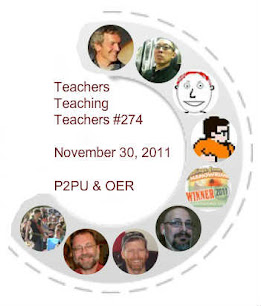
On this episode of Teachers Teaching Teachers
we continue our conversations about Open Educational Resources (OER) with this amazing cast of wonderful teachers!
I’m finding thatP2PU offers a fascinating space in which to operate. It’s a space with ethos but little structure. I’m building as I go. And wondering, from time to time, if this course meets my general metric for success in all that I do as a teacher – is it useful? Are people getting what they need from the course?
Sam Reed, a teacher representative and city representative for Teachers’ Institute of Philadelphia (TIP), and Yale National Initiative (YNIT), respectively. He also serves on the advisory council for the Philadelphia Arts and Education Partnership; the Philadelphia Young Playwrights Literary Committee and I has served on the steering committee of the Philadelphia Writing Project
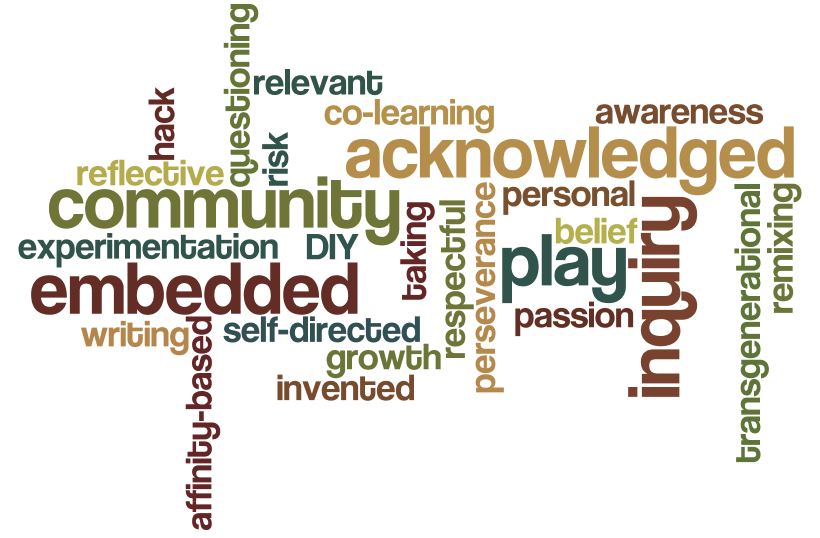
Many of us could probably find our approaches to learning in this definition from one of the more famous DIY projects, :
The DIY ethic (do it yourself ethic) refers to the ethic of being self-reliant by completing tasks oneself as opposed to having others who are more experienced or able complete them for you. It promotes the idea that an ordinary person can learn to do more than he or she thought was possible. Naturally, a DIY attitude requires that the adherent attain the knowledge required to complete a given task. Without this, DIY is not an effective dogma. The term can refer to "doing" anything at all, including home improvements and repairs, first aid, and creative endeavors.
Central to the ethic is the empowerment of individuals and communities, encouraging the employment of alternative approaches when faced with bureaucratic or societal obstacles to achieving their objectives. Rather than belittling or showing disdain for knowledge or expertise, DIY champions the average individual seeking knowledge and expertise for him/herself. Instead of using the services of others who have expertise, a DIY oriented person would seek out the knowledge for him/herself.
Sounds like Teachers Teaching Teachers to us! Enjoy this podcast, and if you find yourself wanting to join these teachers on Youth Voices, please let us know. We would welcome you and your students.
Click Read more to see a copy of the chat that was happening during the webcast.
Enjoy this podcast, recorded 10 days ago, getting ready for ISTE. What are you looking for there? What are you bringing?
Click Read more to see Christina Cantrill's personal list of some of the events where National Writing Project (WP) teachers will be participating as well as the chat that was happening during this webcast.
46:37 minutes (10.67 MB)
Congratulations to all involved in the National Writing Project’s (NWP) new Digital Is site, which launched the first week of November when we recorded this podcast!
Take a look at all the wonderful work that has been collected and curated so far by NWP teachers from all over the United States at http//digitalis.nwp.org/
Once you’ve checked out those great resources and provocations, listen to the creators, collectors, and curators of this exciting new site on this episode of Teachers Teaching
Teachers.
As Christina Cantrill wirtes:
The National Writing Project’s DigitalIs website is a teaching-focused knowledge base exploring digital
writing, teaching and learning. It invites participation in developing
this knowledge base in several ways – visitors can find a range of
teaching-focused collections and resources here related to digital writing, teaching and learning as well as become community members and participate in discussions. Also, after participating and getting a sense of the site, one can write to us and apply to be a resource creator. Resource creators can draft and compose multimodal resources here, get and give feedback to other resource creators, and publish.
Paul Allison, Susan Ettenheim, and Chris Sloan welcomed five of our friends and colleagues to this episode of Teachers Teaching Teachers:
Christina Cantrill
who works at the National Writing Project as a Senior Program Associate
for the NWP Technology Initiative and Digital Is project
Elyse Eidman-Aadahl who directs
National Programs and Site Development at the National Writing Project.
She also moderates one of our favorite webcasts/podcasts, NWP Radio.
Kevin Hodgson teaches sixth grade in Southampton, Massachusetts at the William E. Norris
Elementary School. He is also
the technology liaison with the Western Massachusetts Writing Project. Check out how many different ways Kevin shows up on Digital Is!
We talked with our friends about the importance of commenting. Over
the last several years, those of us who have been building Youth Voices have learned how important it is to teach and nurture commenting, not just posting new posts all the time.
Join the excitement! Digital Is promises to be an important touchstone for communities of learners in the National Writing Project and beyond, and we suspect that the quality of the discussions on the site will soon be as important as the quality of the resources.
With this episode of TTT, we celebrate the launch of Digital Is and to think about the role of commenting in building new communities of learning on this site.
Unfortunately the chat log for this podcast is unavailable.
On the first of these two shows (TTT#151) our guests gave personal definitions for this field of educational research that describes resiliency in students, we asked these Writing Project teachers to describe what it look like in the classroom:
What specific structures, decisions, books, approaches, projects or technologies have you learned to employ in your classroom to provide the "protective factors" that enable "at-risk" students to develop the resiliency they need to succeed?
On this podcast, Paul Allison and Susan Ettenheim were joined for a second time by five Writing Project teachers from around the country:
DeWayne Dickens, Oklahoma State Writing Project
Suzanne Linebarger, Northern California Writing Project
Irina McGrath, Louisville Writing Project
Lynette Herring-Harris, Thinking Partner for Rural Sites Network, Mississippi State University Writing/Thinking Project
Vanessa Brown, Thinking Partner for the Urban Sites Network, Philadelphia Writing Project
Enjoy their conversation! It is laced with provocative questions, inspiring stories, detailed descriptions, and political urgency. In this second podcast, you will hear DeWayne, Suzanne, Irina, Lynette, and Vanessa discussing how resiliency:
helps them to understand and to demand the use of technology to give students voice, social comptency, and power
and provides a important context for the professional development work they do with their colleagues within their own schools in in their Writing Project sites.
That's a mouthful, but we think you'll understand after you listen to these engaging teachers describe the work that resilency has inspired them to do with their students and colleagues. Enjoy!
Do you have your EdTechTalk stuff yet? Did you know there are T-shirts, hats, coffee mugs, buttons, magnets, and tote bags available? They're all based on Wordle interpretations of the EdTechTalk Delicious tags.
What are you waiting for? These are limited edition items. Shop now and avoid the rush!
Recent comments
1 year 2 weeks ago
1 year 3 weeks ago
1 year 3 weeks ago
1 year 7 weeks ago
1 year 7 weeks ago
1 year 15 weeks ago
1 year 25 weeks ago
1 year 26 weeks ago
1 year 26 weeks ago
1 year 27 weeks ago